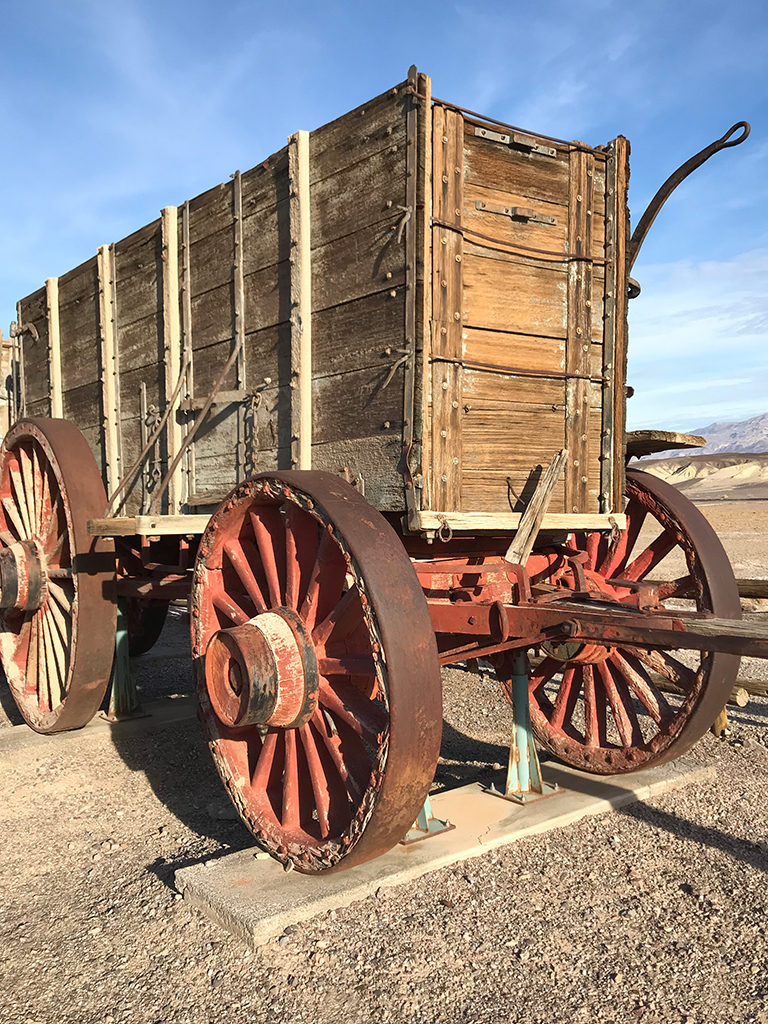
The Harmony Borax Works is located in Death Valley at Furnace Creek Springs, then called Greenland. It is now located within Death Valley National Park in Inyo County, California. It is on the National Register of Historic Places.
Origin and twenty-mule teams
After discovery of Borax deposits here by Aaron and Rosie Winters in 1881, business associates William Tell Coleman and Francis Marion Smith subsequently obtained claims to these deposits, opening the way for "large-scale" borax mining in Death Valley. Coleman constructed Harmony Borax Works and production of borax started in late 1883. In an effort to save money and achieve greater efficiency, Coleman had unique borax wagons designed to get the product to the closest railhead in Mojave, California. The wagons consisted of two box wagons and a water wagon pulled by a team of twenty animals typically consisting of eighteen mules and two horses. While these methods were in use only for a short period of time, from 1883 to 1889, they gained great notoriety and became famous after the fact thanks to the advertising efforts of Stephen T. Mather, who later became the National Park Service's first director.
During the summer months, when it was too hot to crystallize borax in Death Valley, a smaller borax mining operation shifted to his Amargosa Borax Plant in Amargosa, near the present community of Tecopa, California. The Harmony Works remained under Coleman's operation until 1888, when his business collapsed.
Frank M. "Borax" Smith
William Coleman's original holdings in the works were subsequently acquired by Frank M. "Borax" Smith in 1890, to become the Pacific Coast Borax Company with the 20 Mule Team Borax brand. Activity at Harmony Borax Works ceased with the development of the richer Colemanite borax deposits at Borate in the Calico Mountains, where they continued until 1907.
The Harmony Borax Works was placed on the National Register of Historic Places on December 31, 1974. They are part of the National Park Service historical site preservation program in Death Valley National Park.
Visiting Harmony Borax Works
As part of Death Valley National Park, the site is generally open to the public and includes a loop trail and educational interpretation.
See also
- Eagle Borax Works
References
Further reading
- "Borax" Smith is a character in the historical fiction novel Carter Beats the Devil by Glen David Gold (ISBN 0-7868-8632-3).
External links
- Media related to Harmony Borax Works at Wikimedia Commons
- NPS: Death Valley National Park - Harmony Borax Works of Death Valley
- NPS: History of the Twenty Mule Teams
- NPS: official Death Valley National Park
- Historic American Engineering Record (HAER) No. CA-301, "Twenty Mule Team Borax Wagons, Death Valley Junction, Inyo County, CA", 38 photos, 2 color transparencies, 8 measured drawings, 4 photo caption pages
- Death Valley Conservancy: Original Twenty Mule Team Borax Wagons at Harmony Borax Works