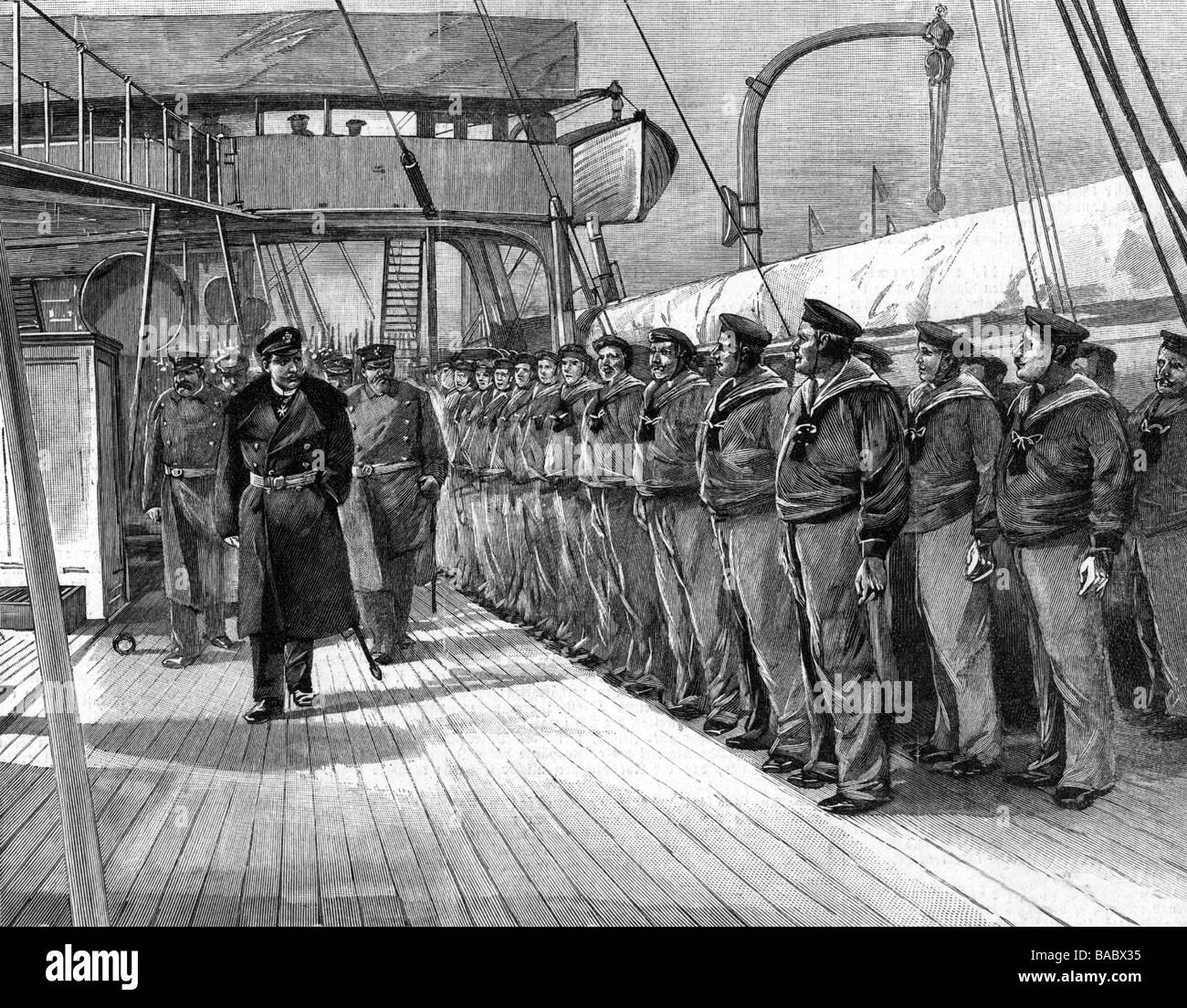
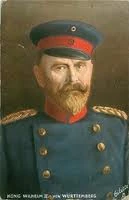
William II (German: Wilhelm Karl Paul Heinrich Friedrich; 25 February 1848 – 2 October 1921) was the last King of Württemberg. He ruled from 6 October 1891 until the dissolution of the kingdom on 30 November 1918. He was the last German ruler to abdicate in the wake of the November Revolution of 1918.
Early years
William was born the son of Prince Frederick of Württemberg (1808–1870) by his wife Princess Catherine Frederica of Württemberg (1821–1898), herself the daughter of King William I of Württemberg (1781–1864). His parents were first cousins, being the children of two brothers, and William was their only child.
William's growing years coincided with a progressive diminution of Württemberg's sovereignty and international presence, concomitant with the process of German unification. In 1870, Württemberg took the side of Prussia in the Franco-German War. In 1871, Württemberg became a state of the German Empire, a significant limitation on its sovereignty.
King of Württemberg
William's father died in 1870, but his mother lived to see him seated on the throne of Württemberg. In 1891, William succeeded his childless maternal uncle, King Charles I (1823–1891) and became King of Württemberg. This was not, as it may seem, a departure from the Salic law which governed succession in the German states; his claim to the throne came because he was the nearest agnatic heir of his uncle, as the senior male-line descendant of Frederick I of Württemberg through his younger son Prince Paul.
King William became a Generalfeldmarschall during World War I. In 1918, he was deposed from the throne along with the other German rulers. King William finally abdicated on 30 November 1918, ending over 800 years of the House of Württemberg rule. He died in 1921 at Bebenhausen.
Personality and interests
Considered to be a popular monarch, William had the habit of walking his two dogs in public parks in Stuttgart without being attended by bodyguards or the like. During these excursions, he would often be greeted by his subjects with a simple Herr König ("Mister King").
Despite living in a landlocked kingdom, William II was a yachting enthusiast. The king was instrumental in the establishment of the Württembergischer Yacht Club (formerly "Königlich Württembergischer Yacht-Club" or Royal Yacht Club of Württemberg) in 1911 on Lake Constance.
Marriages and children
On 15 February 1877 at Arolsen he married Princess Marie of Waldeck and Pyrmont (1857–1882). They had three children:
- Princess Pauline of Württemberg (19 December 1877 – 7 May 1965); married in 1898 William Frederick, Prince of Wied (1872–1945), and had issue.
- Prince Ulrich of Württemberg (28 July 1880 – 28 December 1880), died in infancy
- A stillborn daughter (24 April 1882)
Marie died on 30 April 1882 in Stuttgart, from complications resulting from the birth of their third child. William, already depressed by the death of his only son, is said never to have recovered from this blow.
Nevertheless, he was King and it was his duty to secure the succession. On 8 April 1886, at Bückeburg, he married Princess Charlotte of Schaumburg-Lippe (1864–1946). They had no children.
Succession
On William II's death in 1921 without male issue, the royal branch of the House of Württemberg became extinct, and the headship of the house devolved to Albrecht, Duke of Württemberg, head of the Catholic cadet branch of the dynasty, based at Altshausen. Albrecht was a descendant of Alexander of Württemberg, the 7th son of Frederick II Eugene, Duke of Württemberg (1732–1797).
Honours
- German awards
- Foreign awards
- Austria-Hungary:
- Grand Cross of the Royal Hungarian Order of St. Stephen, 1886
- Military Merit Cross, 1st Class
- Kingdom of Italy: Knight of the Annunciation, 25 September 1893
- Empire of Japan: Grand Cordon of the Order of the Chrysanthemum, 23 May 1896
- Netherlands: Grand Cross of the Netherlands Lion
- Russian Empire:
- Knight of St. Andrew
- Knight of St. Alexander Nevsky
- Knight of the White Eagle
- Knight of St. Anna, 1st Class
- Knight of St. Stanislaus, 1st Class
- Knight of St. George, 4th Class
- Spain: Knight of the Golden Fleece, 3 May 1892
- Sweden: Knight of the Seraphim, 9 July 1913
- United Kingdom: Stranger Knight Companion of the Garter, 23 February 1904 (expelled in 1915)
Arms
Ancestry
See also
- Rulers of Württemberg
References
External links
- Newspaper clippings about William II of Württemberg in the 20th Century Press Archives of the ZBW